> ## Documentation Index
> Fetch the complete documentation index at: https://docs.retellai.com/llms.txt
> Use this file to discover all available pages before exploring further.
# Knowledge base setup and retrieval tuning
> Attach URLs, documents, and custom text to a Retell agent, then tune retrieval with query-rewrite instructions so it answers calls with accurate context.
## Overview
Knowledge bases are a collection of sources of information that your agent can access to retrieve relevant information during the call, which can provide additional context to the conversation. It can greatly improve the quality of the responses and the overall experience, especially in cases where there is a lot of information available (too long for putting in the prompt), but having the information is essential for the agent to respond correctly. This feature is quite useful for use cases like support, helpdesk, FAQ, etc.
Supported sources:
* Website content (via URLs)
* Documents (supported formats: .bmp, .csv, .doc, .docx, .eml, .epub, .heic, .html, .jpeg, .md, .msg, .odt, .org, .p7s, .pdf, .png, .ppt, .pptx, .rst, .rtf, .tiff, .txt, .tsv, .xls, .xlsx, .xml)
* Custom text snippets
* Google Docs, Sheets, and Drive files, synced through [Google Drive knowledge base sync](/integrations/google-drive-knowledge-base)
* Microsoft OneDrive files, synced through [OneDrive knowledge base sync](/integrations/microsoft-onedrive-knowledge-base)
* Notion pages, synced through [Notion knowledge base sync](/integrations/notion-knowledge-base)
Content that lives in an app without a native integration, such as OneNote, can still be used. Export it to a supported format like PDF, DOCX, HTML, or Markdown and upload it as a document. Exported files don't stay in sync with the source app, so re-upload after the content changes.
### How it works
You can create knowledge bases, and link them to your agents. When a knowledge base is linked to an agent, the agent will always try to retrieve information from the knowledge base before responding. There's no need to change your prompt for it to trigger, as it will be done automatically, for every response generation.
During the creation of knowledge bases, it will chunk the sources, embed them, and store them in a vector database.
During the call, when the agent is about to respond, it will use the transcript so far (prompt is not included) to find the most relevant chunks from the knowledge base, and feed them to the LLM as context.
Before searching, Retell condenses the recent conversation into a short, standalone search query and uses that query to find the most relevant chunks. You can steer how this query is built with a Knowledge Base Instruction (see the "Configure Knowledge Base Instruction" step below).
### Auto-refreshing and auto-crawling
You can enable auto-refreshing for URL, Google Drive, OneDrive, and Notion sources in your knowledge base, and auto-crawling for URL paths.
* Auto-refreshing: When enabled, every 24 hours the system re-fetches all URLs in the knowledge base and re-syncs Google Drive files, OneDrive files, and Notion pages whose source changed. If a source can't be re-fetched, or the refresh reaches its time limit before reaching every source, the existing content for those sources is kept unchanged so the knowledge base stays usable. The detail view reports how many sources were affected.
* Auto-crawling: You can enable this feature for specific URL paths. The system will automatically crawl all pages under each path every 24 hours, excluding any URLs you’ve added to the exclusion list. All pages found are stored, except those explicitly excluded.
### Limits
Each knowledge base has the following limits:
* URL: at max 500 URLs.
* Auto-Crawling URL Paths: at max 200 exclusion URLs for each auto-crawling path, and at max 500 exclusion URLs per knowledge base.
* Text: at max 50 text snippets.
* File: at max 25 files, with each file at max 50MB. For CSV, TSV, XLS, and XLSX, the row limit is 1000 rows and the column limit is 50 columns.
You can create multiple knowledge bases to overcome these limits. An agent can have more than one knowledge base linked to it.
## Best Practices
* Prefer `.md` (Markdown) files over `.txt`. Well-structured Markdown is chunked and retrieved more accurately.
* Use clear, descriptive headings and keep each `##` section focused and reasonably short. If a `##` becomes long, split it into multiple `##`/`###` sections.
* Write short paragraphs and lists to separate concepts; avoid walls of text.
* For tabular or image-heavy content, retrieval may be less reliable; consider adding explanatory text so related information stays in the same chunk.
* Group related information within the same section so chunks remain cohesive and relevant.
* Avoid ambiguity and use specificity in references. Include names, dates, units, and avoid ambiguous pronouns like `it` or `this`, because prior chunks may not be present.
* Use more granular paths for auto-crawling instead of broad paths with many exclusion URLs. This improves crawl performance and helps avoid hitting the exclusion URL limits.
* Use the knowledge base to supply supporting information, not agent instructions or prompts. Put instructions in the agent's prompt.
## Use Knowledge Base
1. Navigate to your dashboard
2. Select the "Knowledge Base" tab
3. Click the "Add" button in the top-right corner
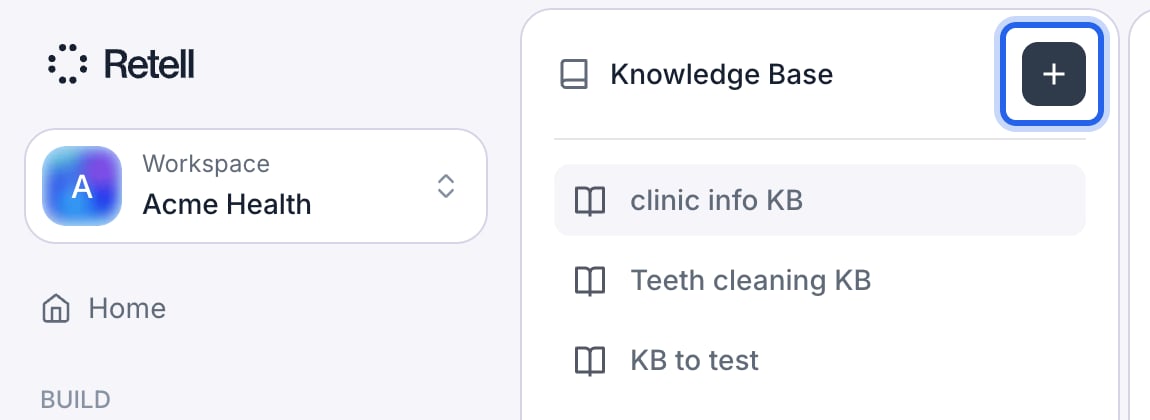 Choose from six types of knowledge sources:
1. **URL**: Import content from web pages
* Supports single pages or entire websites
* Automatically updates when content changes
2. **File**: Upload documents
* Supported formats: PDF, TXT, DOCX, etc.
* Maximum file size: 50MB
3. **Text**: Add custom content
* Paste or type direct information
* Ideal for specific instructions or data
4. **Google Drive**: Sync Docs, Sheets, and files from a connected Drive
* [Connect Google Drive](/integrations/google-drive) first; the Add menu then lists your connected accounts. See [Google Drive knowledge base sync](/integrations/google-drive-knowledge-base) for picking files and how refresh works.
* With auto-refresh enabled, changed files re-sync on the next daily refresh
5. **Microsoft OneDrive**: Sync files from a connected personal or work OneDrive
* [Connect OneDrive](/integrations/microsoft-onedrive) first; the Add menu then lists your connected accounts. See [OneDrive knowledge base sync](/integrations/microsoft-onedrive-knowledge-base) for picking files, supported formats, and how refresh works.
* Microsoft's file picker opens in a pop-up, so allow pop-ups for the dashboard
6. **Notion**: Sync pages from a connected Notion workspace
* [Connect Notion](/integrations/notion) first and share pages with the connection in Notion; the Add menu then lists your connected accounts. See [Notion knowledge base sync](/integrations/notion-knowledge-base) for picking pages, what syncs from a page, and how refresh works.
* Each page is its own source; nested pages are added separately
Choose from six types of knowledge sources:
1. **URL**: Import content from web pages
* Supports single pages or entire websites
* Automatically updates when content changes
2. **File**: Upload documents
* Supported formats: PDF, TXT, DOCX, etc.
* Maximum file size: 50MB
3. **Text**: Add custom content
* Paste or type direct information
* Ideal for specific instructions or data
4. **Google Drive**: Sync Docs, Sheets, and files from a connected Drive
* [Connect Google Drive](/integrations/google-drive) first; the Add menu then lists your connected accounts. See [Google Drive knowledge base sync](/integrations/google-drive-knowledge-base) for picking files and how refresh works.
* With auto-refresh enabled, changed files re-sync on the next daily refresh
5. **Microsoft OneDrive**: Sync files from a connected personal or work OneDrive
* [Connect OneDrive](/integrations/microsoft-onedrive) first; the Add menu then lists your connected accounts. See [OneDrive knowledge base sync](/integrations/microsoft-onedrive-knowledge-base) for picking files, supported formats, and how refresh works.
* Microsoft's file picker opens in a pop-up, so allow pop-ups for the dashboard
6. **Notion**: Sync pages from a connected Notion workspace
* [Connect Notion](/integrations/notion) first and share pages with the connection in Notion; the Add menu then lists your connected accounts. See [Notion knowledge base sync](/integrations/notion-knowledge-base) for picking pages, what syncs from a page, and how refresh works.
* Each page is its own source; nested pages are added separately
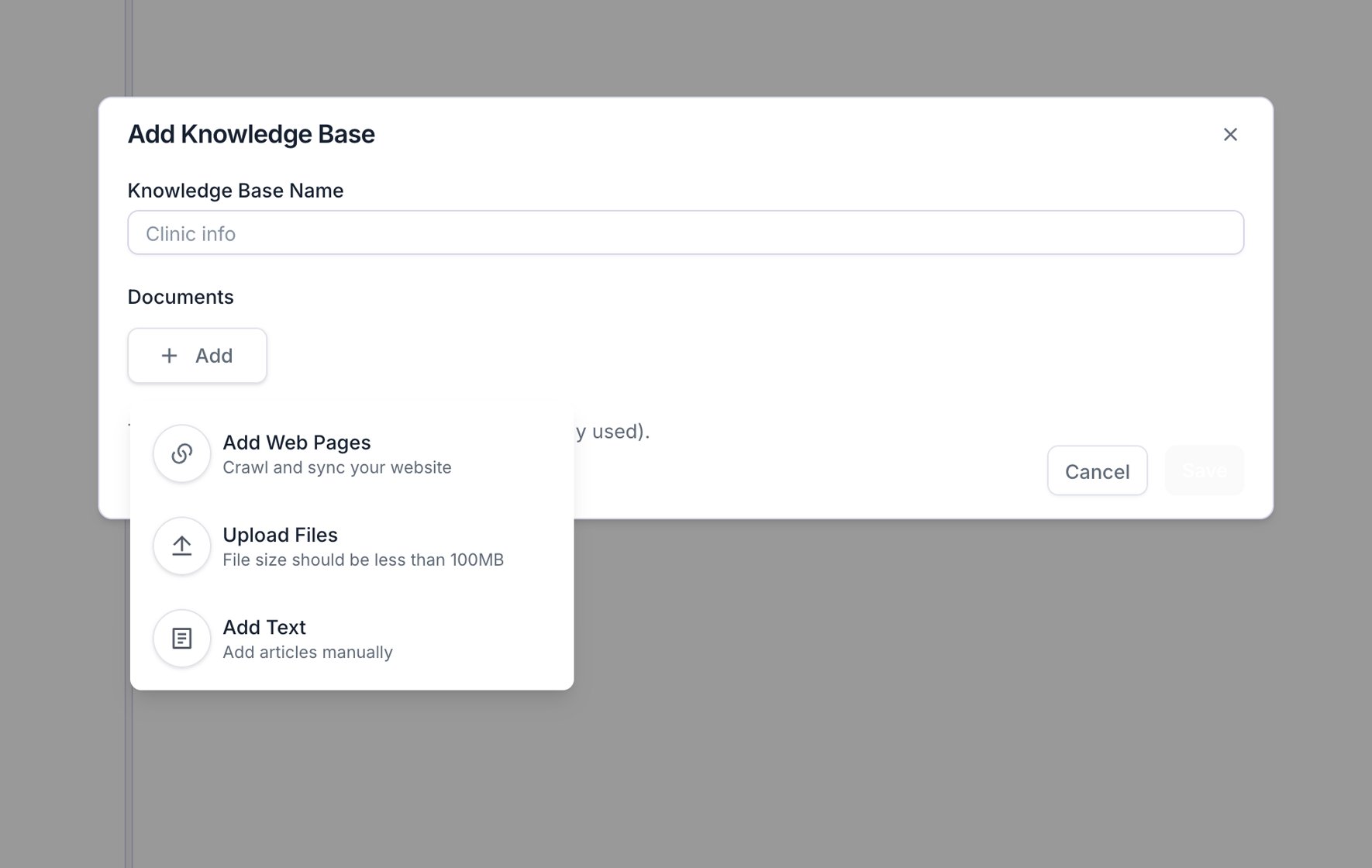 Auto-crawling can be enabled for individual URL paths. URLs that are not selected will be added to the exclusion list and excluded from the knowledge base.
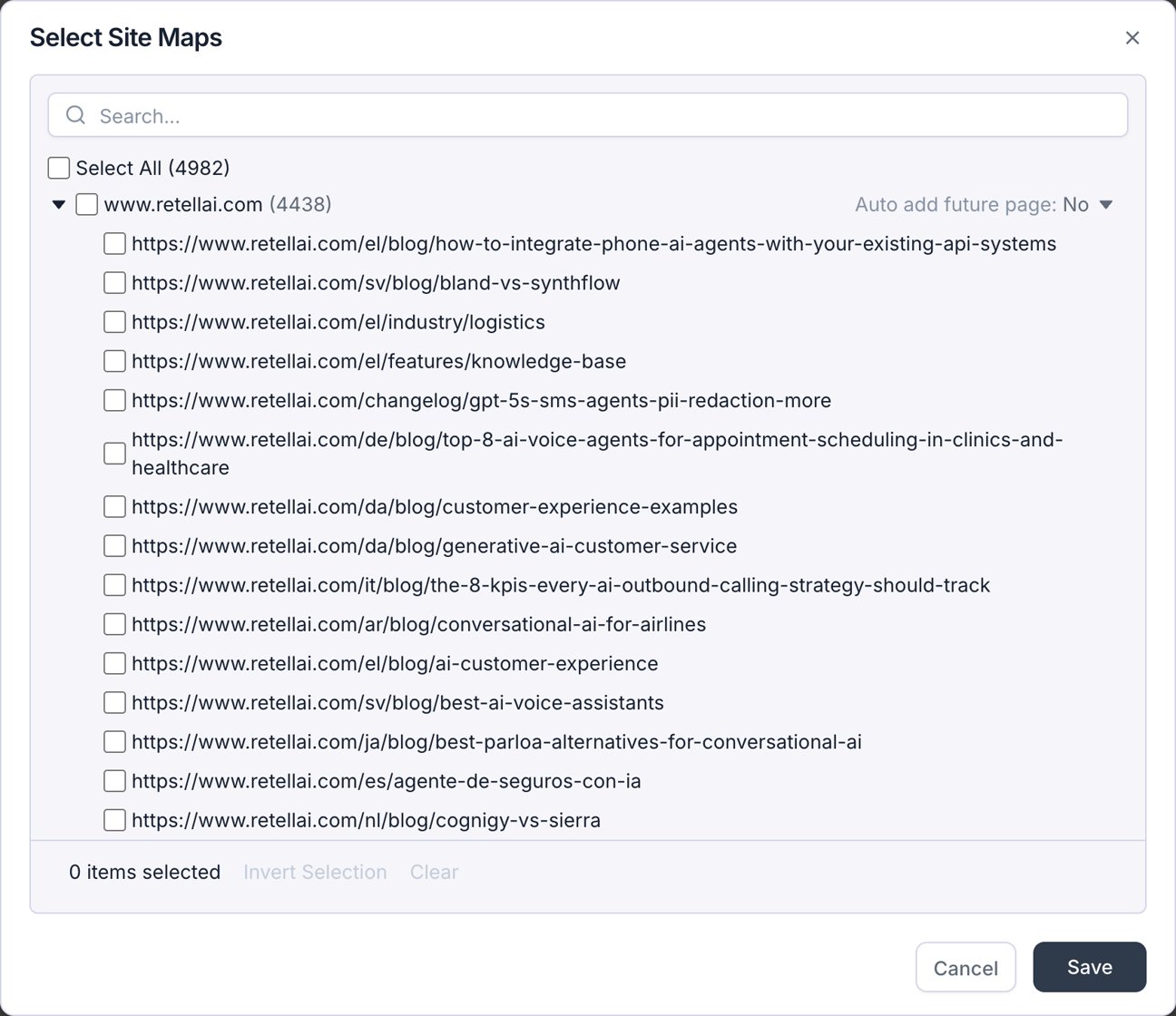 You can edit an auto-crawling path later to add or remove URLs from the exclusion list. Previously crawled URLs (shown in bold) can be excluded, and URLs currently on the exclusion list can be reinstated.
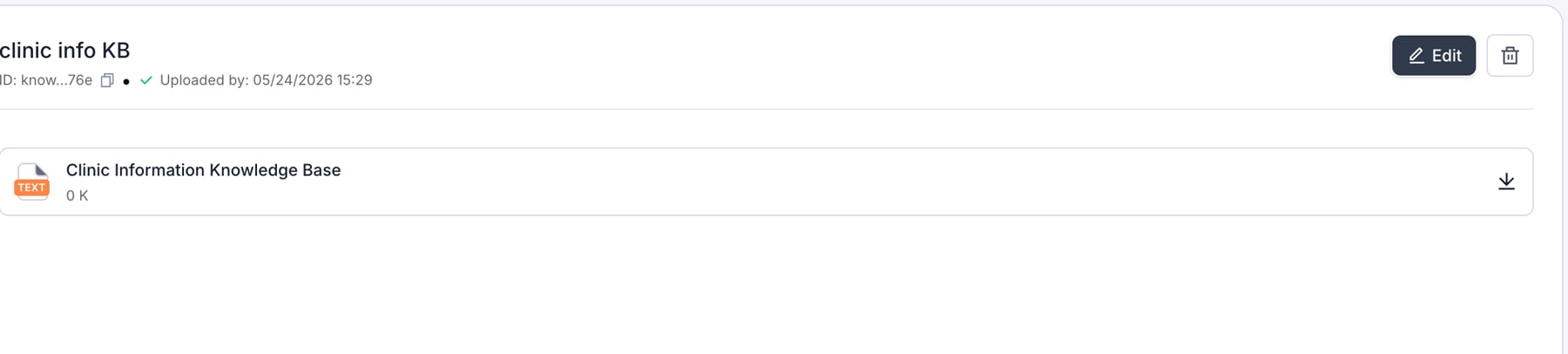
After adding items, they will appear in your knowledge base list. You can:
* View all added items
* Edit existing items
* Delete items when no longer needed
You can edit an auto-crawling path later to add or remove URLs from the exclusion list. Previously crawled URLs (shown in bold) can be excluded, and URLs currently on the exclusion list can be reinstated.
After adding items, they will appear in your knowledge base list. You can:
* View all added items
* Edit existing items
* Delete items when no longer needed
 1. Open the agent editor
2. Locate the "Knowledge Base" section
3. Select the knowledge base items you want to use
1. Open the agent editor
2. Locate the "Knowledge Base" section
3. Select the knowledge base items you want to use
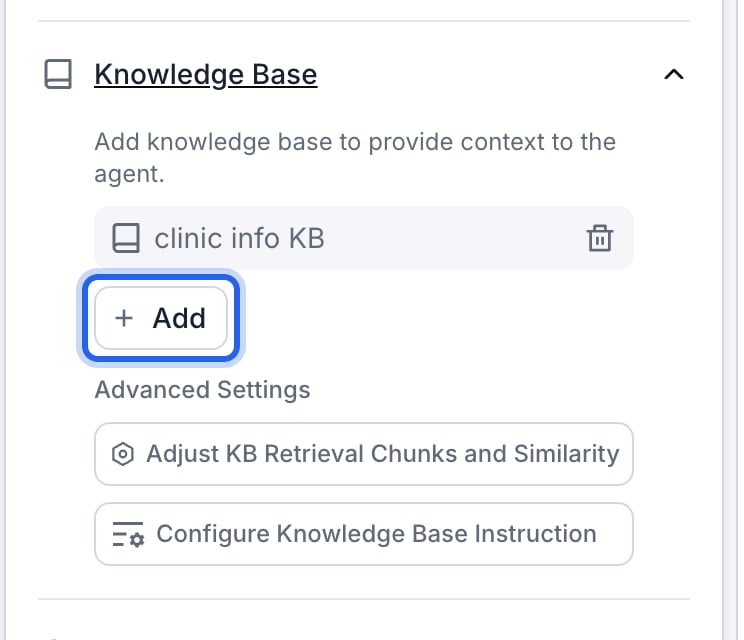 After connecting a knowledge base to your agent, you can configure how many chunks are retrieved via "Adjust KB Retrieval Chunks and Similarity".
* Chunks to retrieve: The max number of chunks to retrieve from the knowledge base, range 1-10. Default: 3.
* Similarity Threshold: Adjust how strict the system is when matching chunks to the context. A higher setting gives you fewer, but more similar, matches. Default: 0.6.
Note: Increasing "Chunks to retrieve" gives the LLM more context, but also increases the prompt length and can interfere with generation quality. For most cases, the recommended settings are 3 chunks and a 0.60 similarity threshold.
After connecting a knowledge base to your agent, you can configure how many chunks are retrieved via "Adjust KB Retrieval Chunks and Similarity".
* Chunks to retrieve: The max number of chunks to retrieve from the knowledge base, range 1-10. Default: 3.
* Similarity Threshold: Adjust how strict the system is when matching chunks to the context. A higher setting gives you fewer, but more similar, matches. Default: 0.6.
Note: Increasing "Chunks to retrieve" gives the LLM more context, but also increases the prompt length and can interfere with generation quality. For most cases, the recommended settings are 3 chunks and a 0.60 similarity threshold.
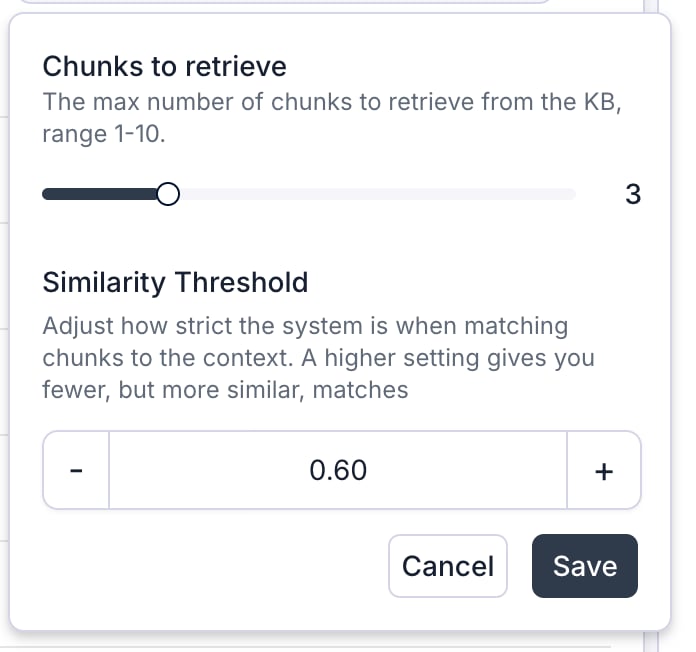 For Conversation Flow Agent, you can configure knowledge base at both Conversation Node level and Subagent Node level. Node-level knowledge base will be combined with the agent-level knowledge base to provide more accurate context for a specific topic.
1. Open the agent editor
2. Click the Conversation Node or Subagent Node you want to configure.
3. Similar to agent level knowledge base config above, you can select and add the knowledge base items you want to use.
For Conversation Flow Agent, you can configure knowledge base at both Conversation Node level and Subagent Node level. Node-level knowledge base will be combined with the agent-level knowledge base to provide more accurate context for a specific topic.
1. Open the agent editor
2. Click the Conversation Node or Subagent Node you want to configure.
3. Similar to agent level knowledge base config above, you can select and add the knowledge base items you want to use.
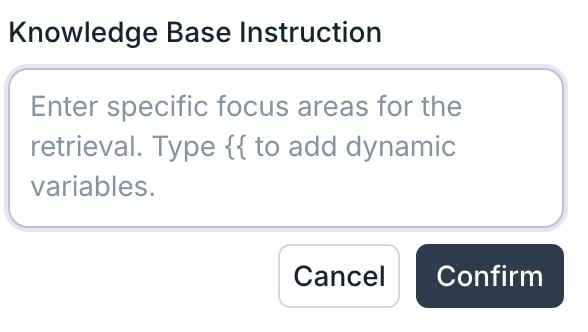
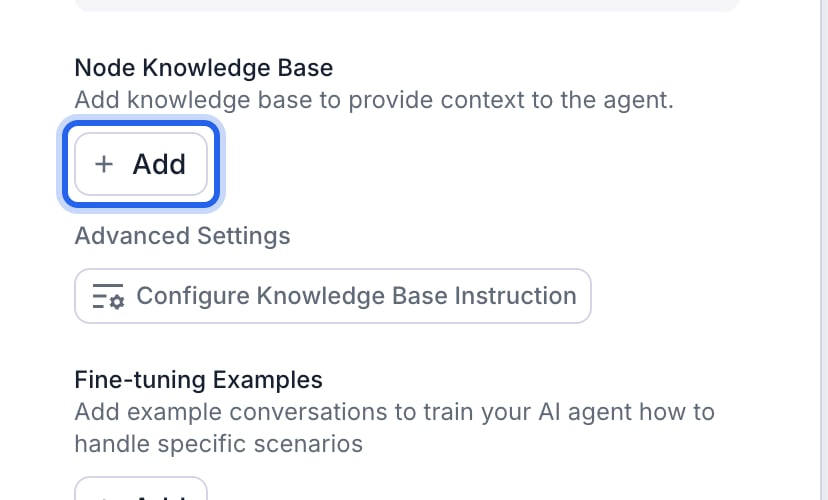 Before searching your knowledge base, Retell condenses the recent conversation into a short search query. The **Knowledge Base Instruction** lets you give that step extra guidance, so the search focuses on what matters for your use case. This setting is optional.
To set it, open the knowledge base's **Advanced Settings**, select **Configure Knowledge Base Instruction**, and enter the specific focus areas for retrieval (see the example below).
* It shapes the search query; it does not filter or rewrite the retrieved chunks. Use "Chunks to retrieve" and "Similarity Threshold" above to control how much content is returned.
* Keep it short and specific (up to 500 characters).
* For most cases you can leave it empty, as the default query building already works well. Add an instruction only when retrieval keeps focusing on the wrong topic or misses context you expect.
For Conversation Flow agents, you can set this per Conversation Node or Subagent Node. A node-level instruction overrides the flow-level instruction while that node is active.
Before searching your knowledge base, Retell condenses the recent conversation into a short search query. The **Knowledge Base Instruction** lets you give that step extra guidance, so the search focuses on what matters for your use case. This setting is optional.
To set it, open the knowledge base's **Advanced Settings**, select **Configure Knowledge Base Instruction**, and enter the specific focus areas for retrieval (see the example below).
* It shapes the search query; it does not filter or rewrite the retrieved chunks. Use "Chunks to retrieve" and "Similarity Threshold" above to control how much content is returned.
* Keep it short and specific (up to 500 characters).
* For most cases you can leave it empty, as the default query building already works well. Add an instruction only when retrieval keeps focusing on the wrong topic or misses context you expect.
For Conversation Flow agents, you can set this per Conversation Node or Subagent Node. A node-level instruction overrides the flow-level instruction while that node is active.
 Your agent will now use this information when responding to queries related to the added content. Retrieved knowledge base content will be appended to the LLM prompt under the header **## Related Knowledge Base Contexts**. Because these chunks are part of the prompt, they count toward the [prompt token surcharge](/accounts/billing-exceptions#rule-2-llm-price-scaling-for--4000-token-prompt-length). Retrieving more chunks raises the token count.
## Check what the agent retrieved
To see exactly which chunks the agent pulled on a given turn, open the call in [Call History](/features/session-history) and go to its transcript. Any agent message that used the knowledge base shows a **Knowledge Base Retrieval** link above it.
Your agent will now use this information when responding to queries related to the added content. Retrieved knowledge base content will be appended to the LLM prompt under the header **## Related Knowledge Base Contexts**. Because these chunks are part of the prompt, they count toward the [prompt token surcharge](/accounts/billing-exceptions#rule-2-llm-price-scaling-for--4000-token-prompt-length). Retrieving more chunks raises the token count.
## Check what the agent retrieved
To see exactly which chunks the agent pulled on a given turn, open the call in [Call History](/features/session-history) and go to its transcript. Any agent message that used the knowledge base shows a **Knowledge Base Retrieval** link above it.
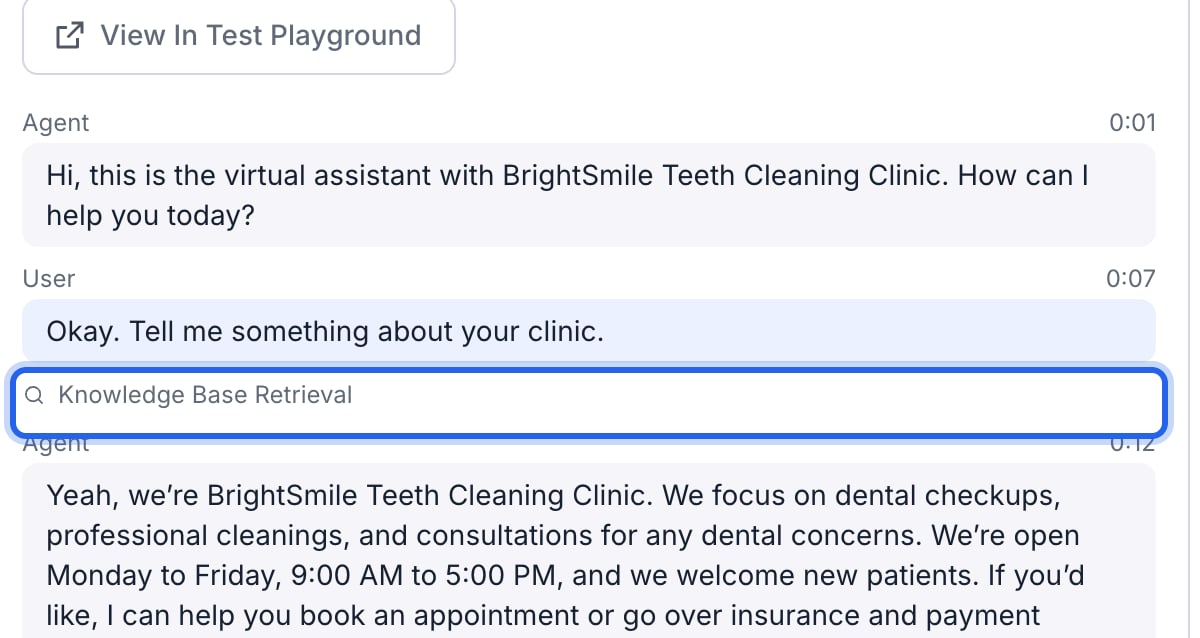 Select the link to open a dialog that lists each retrieved chunk (**Chunk 1**, **Chunk 2**, and so on). Each chunk is the exact text passed to the LLM for that response. Expand a chunk to read it in full.
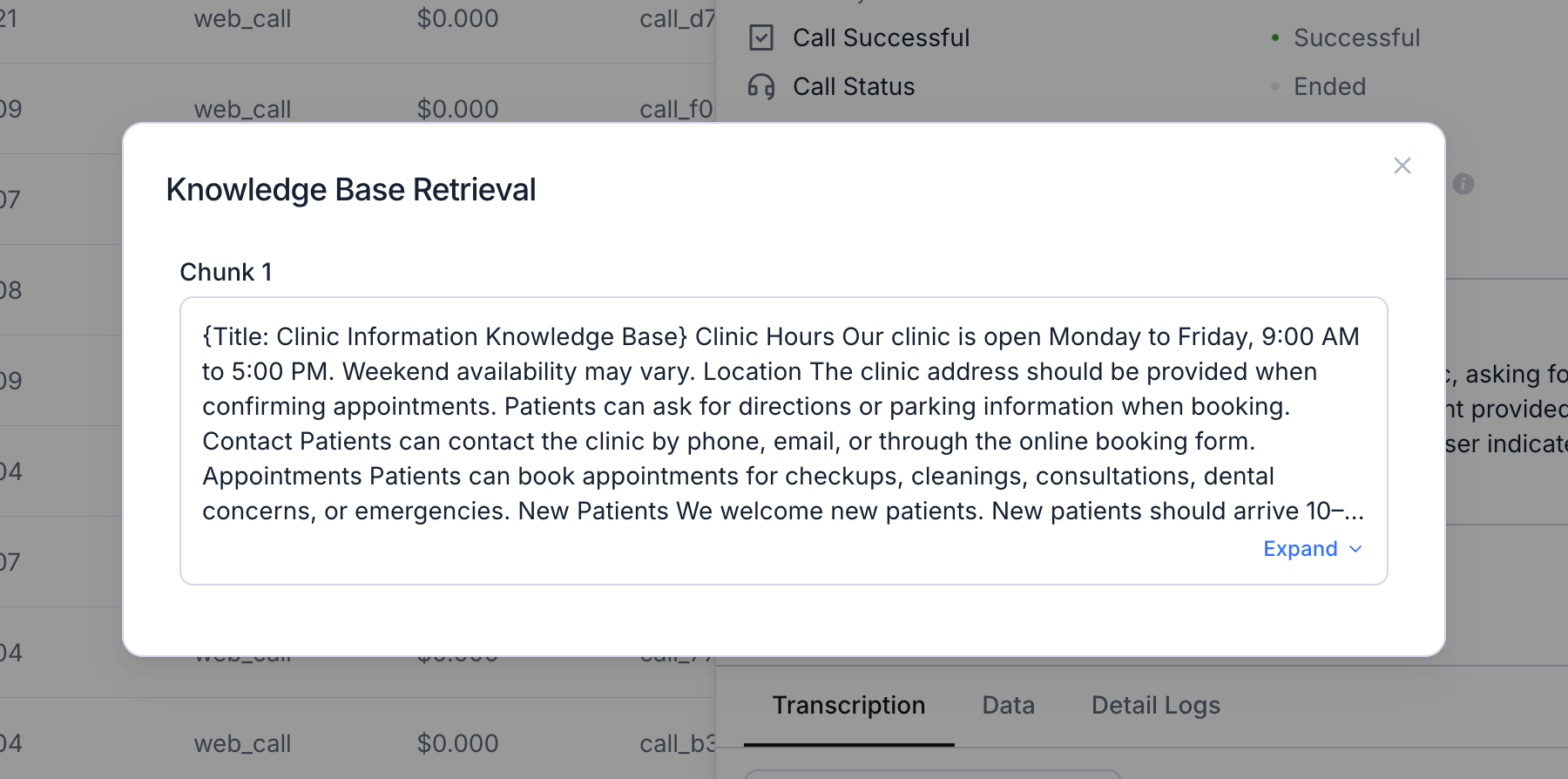 Use this to debug retrieval. If the agent answered incorrectly, check whether the relevant chunk was retrieved. If it wasn't, raise **Chunks to retrieve**, lower the **Similarity Threshold**, or improve your source formatting (see [Best practices](#best-practices)). If the chunk was retrieved but the agent ignored it, fix the agent's prompt. The same retrieval view is available in [Chat History](/features/session-history) for chat agents.
## FAQ
No, you don't need to change your prompt. It will be used automatically when added to an agent.
You can add the following prompt to the agent:
```
Only answer using the information in ## Related Knowledge Base Contexts.
If ## Related Knowledge Base Contexts is missing or does not contain relevant information, respond:
"There is no related information in knowledge base."
```
Please check the knowledge base documents to see if the information is correct. And check the format of the source as suggested above; markdown format with clear paragraphs is recommended.
We've optimized Knowledge Base retrieval latency for real-time use cases, so it should generally be under 100ms of latency impact.
No, the name is for display purposes only. It's not included in the retrieval process.
A source that fails to process doesn't block the others. If only some sources fail, the knowledge base still finishes and works with the sources that succeeded. Its detail view shows **Some knowledge base sources could not be processed:** followed by the sources that failed.
If the whole knowledge base fails to process, its status shows **Failed** and the detail view shows **Failed to process the knowledge base:** with the error details.
To clear the notice, select **Ignore**. To fix a failing source, re-add it after resolving the cause, for example an unreachable URL or a file that exceeds the supported format or size limits.
A refresh never discards content it can't update. If a source (a URL, a Google Drive file, a OneDrive file, or a Notion page) fails to refresh, its existing content is kept, and the detail view shows **Refresh completed with N errors. Existing content was retained for sources that could not be refreshed.** If the refresh reaches its time limit before reaching every source, the remaining sources are also left unchanged, and the detail view shows **Refresh reached its time limit after processing X of Y sources. The remaining sources were retained unchanged.**
Both cases run again automatically on the next 24-hour refresh, so a transient timeout or a slow site usually resolves on its own. Select **Ignore** to clear the notice.
Before each retrieval, Retell turns the recent conversation into a short search query. The Knowledge Base Instruction is extra guidance for building that query, for example telling it which topics or terms to prioritize. It influences what is searched for, not how results are filtered or ranked. It's optional, limited to 500 characters, and can be set per node for Conversation Flow agents. See the "Configure Knowledge Base Instruction" step above.
## Pricing
* Knowledge base creation:
* First 10 knowledge bases are free.
* Additional ones are billed at \$8 / month per knowledge base.
* Using knowledge base:
* \$0.005 per minute of calls that have knowledge base enabled.
* It does not matter if your agent is using 1 or many knowledge bases, the billing is the same.
Use this to debug retrieval. If the agent answered incorrectly, check whether the relevant chunk was retrieved. If it wasn't, raise **Chunks to retrieve**, lower the **Similarity Threshold**, or improve your source formatting (see [Best practices](#best-practices)). If the chunk was retrieved but the agent ignored it, fix the agent's prompt. The same retrieval view is available in [Chat History](/features/session-history) for chat agents.
## FAQ
No, you don't need to change your prompt. It will be used automatically when added to an agent.
You can add the following prompt to the agent:
```
Only answer using the information in ## Related Knowledge Base Contexts.
If ## Related Knowledge Base Contexts is missing or does not contain relevant information, respond:
"There is no related information in knowledge base."
```
Please check the knowledge base documents to see if the information is correct. And check the format of the source as suggested above; markdown format with clear paragraphs is recommended.
We've optimized Knowledge Base retrieval latency for real-time use cases, so it should generally be under 100ms of latency impact.
No, the name is for display purposes only. It's not included in the retrieval process.
A source that fails to process doesn't block the others. If only some sources fail, the knowledge base still finishes and works with the sources that succeeded. Its detail view shows **Some knowledge base sources could not be processed:** followed by the sources that failed.
If the whole knowledge base fails to process, its status shows **Failed** and the detail view shows **Failed to process the knowledge base:** with the error details.
To clear the notice, select **Ignore**. To fix a failing source, re-add it after resolving the cause, for example an unreachable URL or a file that exceeds the supported format or size limits.
A refresh never discards content it can't update. If a source (a URL, a Google Drive file, a OneDrive file, or a Notion page) fails to refresh, its existing content is kept, and the detail view shows **Refresh completed with N errors. Existing content was retained for sources that could not be refreshed.** If the refresh reaches its time limit before reaching every source, the remaining sources are also left unchanged, and the detail view shows **Refresh reached its time limit after processing X of Y sources. The remaining sources were retained unchanged.**
Both cases run again automatically on the next 24-hour refresh, so a transient timeout or a slow site usually resolves on its own. Select **Ignore** to clear the notice.
Before each retrieval, Retell turns the recent conversation into a short search query. The Knowledge Base Instruction is extra guidance for building that query, for example telling it which topics or terms to prioritize. It influences what is searched for, not how results are filtered or ranked. It's optional, limited to 500 characters, and can be set per node for Conversation Flow agents. See the "Configure Knowledge Base Instruction" step above.
## Pricing
* Knowledge base creation:
* First 10 knowledge bases are free.
* Additional ones are billed at \$8 / month per knowledge base.
* Using knowledge base:
* \$0.005 per minute of calls that have knowledge base enabled.
* It does not matter if your agent is using 1 or many knowledge bases, the billing is the same.