> ## Documentation Index
> Fetch the complete documentation index at: https://docs.retellai.com/llms.txt
> Use this file to discover all available pages before exploring further.
# Balance between transcription accuracy and latency
> Pick the right Retell transcription mode to balance accuracy against latency — interim results for speed or context-aware results for higher accuracy.
This guide only applies to cascading agents, if you are using speech to speech models, this feature does not apply.
Real time transcription is a trade off between latency and accuracy. Two concepts drive this trade off:
* **Interim results**: early, partial transcripts produced while the user is still speaking. They arrive fast but are generated with less context, so they contain more errors.
* **Endpointing**: how long the transcriber waits after the user stops speaking before finalizing the transcript. Waiting longer gives the model more context and produces more accurate transcripts, at the cost of a slower response.
## Transcription modes
Retell offers two transcription modes:
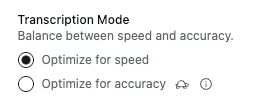 * **Optimize for speed**: uses the latest interim results with a low endpointing setting for downstream processing. This gives the lowest latency.
* **Optimize for accuracy**: uses results generated with a higher endpointing setting for downstream processing. The transcriber waits longer with more context to generate more accurate transcripts. This adds roughly 200ms of latency.
## Which mode to use?
From our benchmarking, the two modes have a similar overall WER (Word Error Rate). The difference mainly lies in capturing entities like numbers and dates.
* Use **optimize for accuracy** if your use case relies heavily on capturing entities like phone numbers, account numbers, or dates correctly.
* Use **optimize for speed** for the best latency in all other cases.
* **Optimize for speed**: uses the latest interim results with a low endpointing setting for downstream processing. This gives the lowest latency.
* **Optimize for accuracy**: uses results generated with a higher endpointing setting for downstream processing. The transcriber waits longer with more context to generate more accurate transcripts. This adds roughly 200ms of latency.
## Which mode to use?
From our benchmarking, the two modes have a similar overall WER (Word Error Rate). The difference mainly lies in capturing entities like numbers and dates.
* Use **optimize for accuracy** if your use case relies heavily on capturing entities like phone numbers, account numbers, or dates correctly.
* Use **optimize for speed** for the best latency in all other cases.